
Marrying Libraries

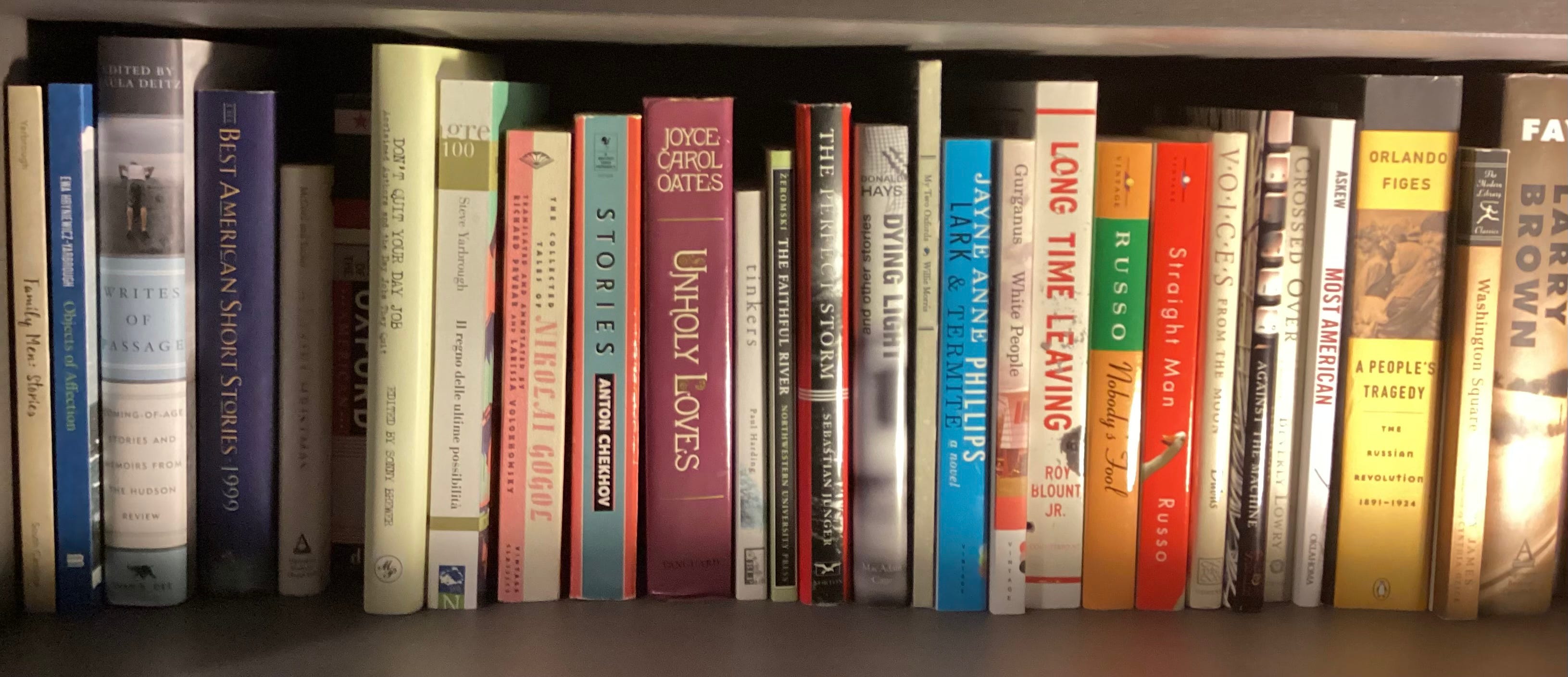
When I first arrived in the US for my two-year academic exchange program, I was almost bookless. I had only brought with me two unlikely bedfellows: James Joyce’s Ulysses and Zbigniew Herbert’s Barbarzyńca w ogrodzie (Barbarian in the Garden). A life-long book lover, I had a large home library in Poland. Why then did I choose those two books? I had fallen in love with Barbarian, reread it many times. I might have treated it as a token of home. Joyce’s Ulysses was difficult and demanding. I had read it only once, and most of the time I felt lost. Maybe I wanted to embrace the challenge and read it again in an English language environment. I could speculate further, but the honest answer is I have no idea what lay behind my decision to bring along those books. I still have both copies in my study. And while I can easily locate Herbert’s Barbarian—all his works occupy a single shelf—Joyce’s Ulysses required some digging. I had bought it during my stay in England in the summer of 1973. Herbert’s essays came from a second-hand bookstore in Wrocław in 1976. The fact that I remember when and where I purchased them says something about their importance to me.
I knew that as a graduate student at the English department, I’d soon own more books. I fully intended to ship them back to Poland when I was finished with my studies and thus enlarge the stock of the English-language books I had at home. That would have happened if I hadn’t met my future husband at an orientation session for teaching assistants and first year lecturers. During the first break in the session, coffee and cookies were served in an adjoining room. I didn’t know anyone and had decided to stay seated, but a tall stranger approached and asked if I’d join him for coffee. Earlier, when all of us introduced ourselves, he had heard me say that I was from Poland. When we sat down with our coffees, he asked me if I liked the poetry of Tadeusz Różewicz. That was a perfect conversation opener. I told him the poet lived in Wrocław, the city where I had attended university and worked. I was surprised that he was familiar with the poet’s work and suspected that was the only Polish author’s name he knew. But I was proven wrong. Steve hadn’t just thrown the poet’s name into our conversation to impress me. The first time I went to his house, I spotted Różewicz’s collection of poems on his shelf next to Bells in Winter by Czesław Miłosz, A Minor Apocalypse and The Polish Complex by Tadeusz Konwicki, and Bruno Schulz’s Sanitorium Under the Sign of the Hourglass and a host of books by Czech and Hungarian writers. In the years since, he’s acquired hundreds of books in translation by writers from Central Europe.
When I moved in with him, I saw that he already had most of the English classics and lots of books by contemporary American writers whose names I didn’t know, like Richard Yates, Andre Dubus and Elisabeth Spencer. Compared with his large collection, the number of the books I called mine was small. They fit on two shelves of a bookcase that he emptied of his books and bestowed on me. It took a while to fill them. My books were all in English until I began buying Polish titles from a couple of Polish bookstores in the US. After the downfall of communism in Poland, I could travel back to my native country, and each time I returned I brought new books with me. When we moved from Virginia to California, in 1988, we added a couple of large built-in bookcases to accommodate our continually growing collection. By the time we moved to Masschusetts in 2009, our home library was so large that we decided to give away more than a thousand books. We haphazardly packed the 3500 or so that we were keeping, which had never been properly arranged anyway. We promised ourselves that once we were in our new house, we’d take time and organize them according to some logical principle.
Unfortunately, we failed to fulfill that promise. There was simply too much other stuff to unpack. My Polish books were in marked boxes, so I carried them to the room that became my study. I now have a lot of other books there as well as a number of dictionaries, among them two huge volumes of The New Shorter Oxford. My initial plan was to keep them organized by genre, and within each genre to group them by the author’s name. Needless to say, that didn’t last long. As I kept adding new books I had to double the rows on broader shelves and put the latest acquisitions where I found space. By now only the shelves with Polish poetry and poets’ essays are ordered. I suspect that despite all my resolutions the books will remain where they are. At least their arrangement has nothing boring about it.
The other bookcase in our household where the books follow an orderly sequence holds English-language poetry. I take credit for their alphabetical arrangement. My one attempt to arrange by country the other books on the first floor was successful until Steve decided to move all the Irish writers to his study. I was away at the time and couldn’t intervene and insist he preserve the original order. He filled the empty spaces with books that didn’t belong there. You can now see The Savage Detectives by Roberto Bolaño next to Tessa Hadley’s The Master Bedroom. Some books resisted this descent into chaos, but the original arrangement is gone.
The rest of our books on all three floors are shelved “creatively,” with little rhyme or reason, though some writers’ books—for example, Faulkner’s—have miraculously ended up together, an exception to the general lawlessness that governs our home library. The anarchy doesn’t bother us until one of us starts searching for a particular title. To find it often takes a long time. A few times we convinced ourselves the book was lost and bought a new copy only to discover later that it was shoved between two books with no spine showing.
Our books reflect our different interests, tastes and personalities. Sometimes they bring a look of puzzlement to a guest’s face when he or she is scanning the titles. We treat them all as “ours,” although we have several bookshelves for the books each of us refers to as “mine.” I have more of those “mines” than Steve for the obvious reason that he can’t read Polish. I also have several shelves of books on art and art albums that I persist in calling “mine” despite the fact that Steve has added to the collection. Some books, though, are strictly Steve’s as I don’t share his interest in footall, bluegrass music, or the American Civil War. It can be said that except for occasional spats when one of us can’t find the needed book and accuses the other of misplacing it, we live in conjugal peace. When we got married, for better or worse, we also married our libraries.
Love this. Love how you also show how books reveal our identities. Some of them can be merged. Others can't be. Thanks, Ewa. More please.
Lovely, the story of how you two met. How fitting. "Barbarian in the Garden is one of my favorite Herbert books, too.Read and reread it. I take perverse heart in knowing that your tempts to arrange your books are largely unsuccessful. The bookshelves I built that line the wall and sit over the forwards in our dining room are to a degree organized, But if you walked into my study you'd be under threat of a book avalanche. unorganized. stacked 3 deep. One big difference is that Mary and I never merged our separate book collections.