
Longhand

Next year it’ll be thirty years since I started keeping a journal.
I write in it longhand. Several times in the past I told myself I needed to stop using paper notebooks and switch to the computer. Typing would result in a more readable text and would be more convenient. But the argument for convenience was easily demolished. A notebook is lighter and smaller than a computer and I can take it everywhere I go. When something attracts my attention, I pull the notebook out of my purse and jot down my random thoughts. Don’t get me wrong. I do use a computer for other kinds of writing. My journal, though, has remained an outpost that refuses to surrender to the lure of technology.
What’s more, and what’s more important, the typed journal entries had an air of wrongness about them. They seemed written by someone who wasn’t me, someone trying to be on her best behavior to make a good impression on herself. The internal censor absent from my handwritten notes appeared in my entries on the computer. I not only paid attention to the style of my notes. I began to delete the ideas I deemed vapid as if I weren’t the journal’s sole reader and were writing a text I wanted to submit to a literary journal. The closeness between me and the words I put down on paper seemed gone along with the synchronicity between thought and word. The handwritten notes seem more intimate, more personal. When I compose a text on the computer I feel obliged to keep editing it as I write—no freewriting there there for me. The medium imposes its own demands. And it’s true that my longhand journal entries bear seeds that later may grow into an essay.
Typing journal notes on the computer deprives me of the sense of physicality I experience when I write in longhand. I like using my hand, holding the pen between my forefinger and thumb and feeling the pressure of the pen on the page. I can see different shapes of the letters, neat or warped, depending on how my hand feels, how I feel. When I later look at the entries, the appearance of the writing communicates a lot about my state of mind. Was there urgency in what I wrote, resulting in untidy scribbles? Or was I putting the words down slowly and carefully? I realize that all this may seem like a silly affectation. Why bother if typing produces a perfect copy? But I want visible imperfection. Maybe writing by hand helps me preserve something that harks back to my youth and brings back memories of the times when even typewriters were scarce in my native Poland.
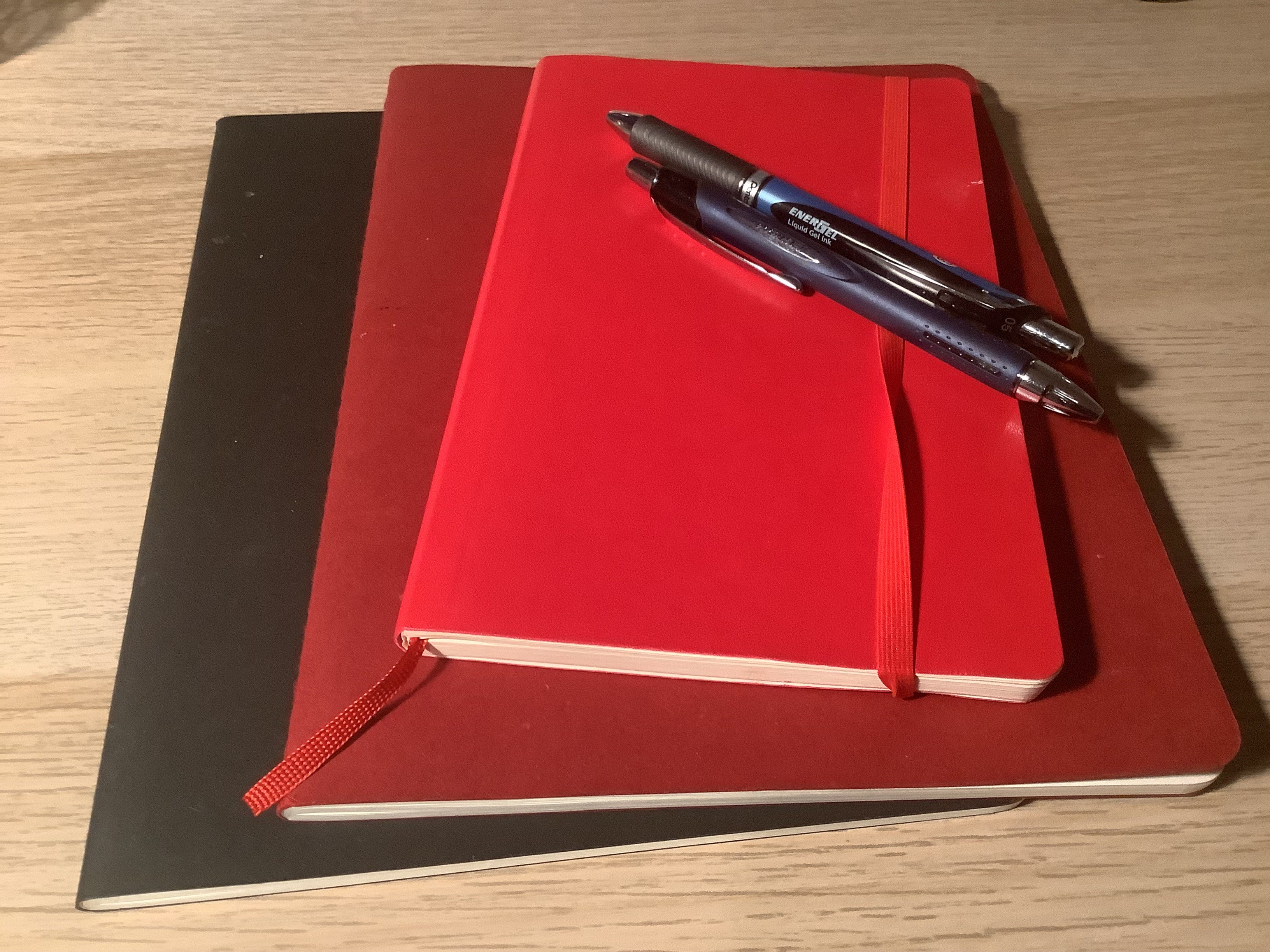
What I’ve just written explains my love of notebooks. I have several blank ones awaiting their turn. The ones that are filled occupy a shelf in my study, all twenty of them. The first one, spiral bound from 1997, keeps company with five others, the standard college kind I bought at a drugstore. They weren’t designed with longevity in mind. The black ribbon on their spines got loose in no time. Then there’s a lovely leather-bound one, a gift from my husband, with the word Journal embossed on the cover. Afterwards I became a faithful user of Moleskins.
I’ve always had a weakness for writing implements. I went through a phase of fountain pens and even bought a few that were better than average and required good quality ink. I no longer use them, though I still keep them in a wooden box. They are aesthetically pleasing but not practical enough. They tend to leak if you place them in checked baggage on a plane. These days I write with gel pens when I travel. At home I write with Kaweco pens. They have cartridges which keep them from staining things. I have three of those, two with a fine nib, one with medium. The medium one works well when I want to pay attention to my lettering. What I like most about those pens is their size. They’re much smaller than their standard counterparts.
Studies confirm the closer connection between handwriting and brain. Some even claim that longhand writing enhances creativity. I don’t know about that. I like the slowness of writing with a pen because it allows for both deeper reflection and spontaneity. I’m never at a loss about what to write. I don’t need AI journaling to suggest topics. I hope that longhand writing won’t disappear
Bravo Ewa! I don't know if it's the same analog generation, or a kinship of souls and hands. Handwriting and collecting pencils (and pencil sharpeners, for that matter) are my weaknesses. And... I can't imagine writing the first draft of a poem in any other way than by hand.
Ah, friends ARE mirrors... I've kept hand written journals (sometimes in notebooks with a hand-made cover - made with my own hands) for years, since my primary school... then I had a long break in my forties... and came back to the club. Fountain pens were my favorite. Still have some. All my articles start with my hand-written notes, paragraphs, and sketches - in separate "creative writing" notebooks, and strangely - those entries are almost always in pencil. Erasable - but I don't erase? Yes, the connection between the hand and the brain, but also - the hand and the energetic state of the body... it all shows in the shapes of letters and in the flow of lines. So glad you wrote that essay - as always, simple yet complex, elegant, reflective... and about being.